
LAYING THE GROUNDWORK FOR ADVENTISM
In the 1830s, a farmer, military veteran, and devout Baptist named William Miller continued the fervor of the spiritual “awakening” and sought to deepen his Bible study. Especially after returning from war and being frequently reminded of the fragility of life and the mystery of beyond, he focused on studying prophecy in Daniel and Revelation.
He eventually concluded Christ’s Second Coming would be a literal event rather than a figurative or spiritual event, which had been the popular reasoning at the time.
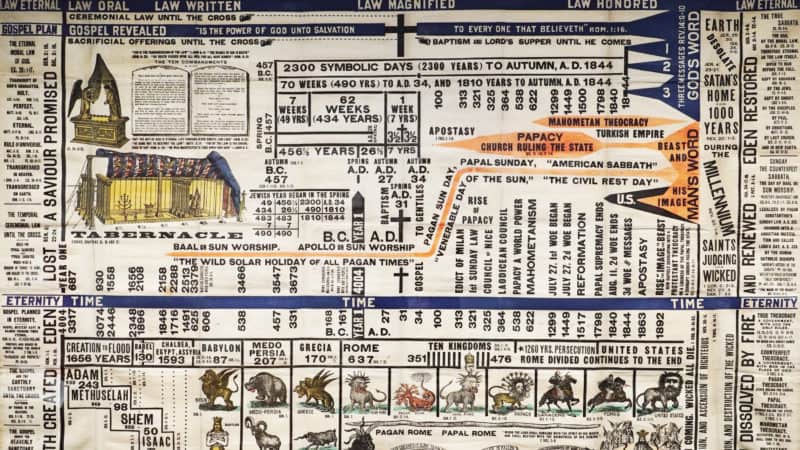
As he continued to study the “2300-day prophecy” in Daniel 8 and 9, he became convinced this predicted exactly when the Second Coming would be. Based on the events described in these passages, he believed the 23002 days began in 457 BC with the call to rebuild the city of Jerusalem, and concluded at some point between 1843-1844.
As Daniel 8:14 says,
“And he said to me, ‘For 2,300 evenings and mornings. Then the sanctuary shall be restored to its rightful state” (ESV).
Miller believed this to refer to the Second Coming, interpreting the earth to be the sanctuary. He preached fervently about the nearness of this Second Coming, which inspired many to take stock of their lives and focus on Bible study. He gained many followers who took his theories as literal predictions and eventually a date was set: October 22, 1844.
Obviously, however, the literal Second Coming of Christ did not happen by October 22, 1844. Miller’s followers, then called “Millerites,” were devastated. That day became known as “The Great Disappointment.”


